A few weeks ago, a car mounted the footpath and ran over my foot, leaving me injured. I’m still limping a month later, but I will certainly recover. What’s harder to heal from is the realisation that the Indian pedestrian lives a precarious life. I wasn’t jaywalking. I was exactly where I was supposed to be on the footpath. Yet, a car climbed onto the pavement and struck me anyway. The photograph below shows the tree-lined road full of government offices, where a car ran over my foot. A pedestrian isn’t safe even in the capital city of India, in an expensive neighbourhood, on a footpath. It points to a deeper failure of urban management, in which design, enforcement, and accountability consistently underperform.
India’s urban management neglects the primary user of the streets, pedestrians. A 2019 survey found that pedestrians accounted for 63% of trips in urban India. However, the infrastructure of most cities doesn’t reflect this reality. A study found that 44% of roads in Delhi have no footpaths.
Anyone who has walked on Indian streets knows what it’s like to deal with broken footpaths and careless driving. Drivers often ignore zebra crossings. Footpaths are broken or obstructed, sometimes by parked vehicles. Crossing the road can require navigating fast-moving traffic with little protection, especially for children or the elderly. Even without data, it’s clear that walking in many Indian cities involves a degree of risk which often leads to serious injury or even death.
In Delhi, nearly half of all road crash deaths are pedestrians. In Chennai, the share of pedestrian deaths has shot up from just 11% of total fatalities in 2019 to 43% in 2023. This data shows that cities need to focus more on safe footpaths, crossings, and traffic management to cut these numbers.
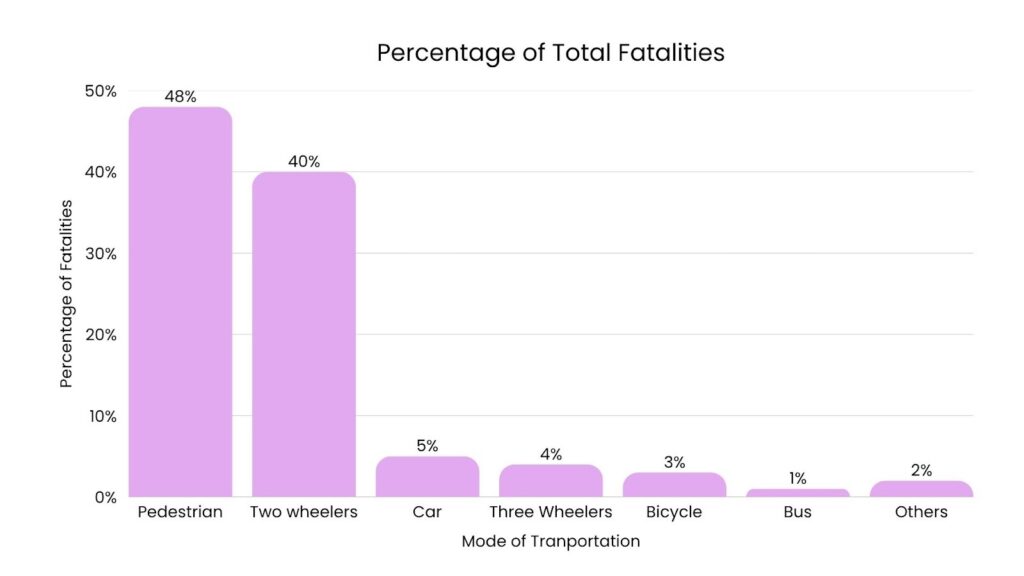
A Bosch report based on 2021 data finds that 99% of Indian pedestrians are at risk of injury. That year, there were 60,000 pedestrian crashes, resulting in 29,200 fatalities; 91% were due to human error, 63% due to poor infrastructure, and 44% due to vehicle issues. The vast majority of Indians, including you, could be the victim of a system that fails to protect its most basic road users.
A report in Nagpur found 6 out of 7 evaluated roads failed basic design and safety standards. These roads had discontinuous footpaths, encroachments, unsafe junctions, and missing cycle lanes, indicating a broader pattern of gaps in basic street design and safety standards across cities. This failure becomes even more concerning when placed alongside the scale and priorities of public investment in urban roads.
Public investment in roads and highways has surged to over Rs. 2.8 lakh crore annually, reflecting a strong policy focus on vehicle infrastructure. Yet, this investment has not translated into safe spaces for pedestrians. 44% of roads in Delhi lack footpaths, and in cities like Ahmedabad, nearly 72% of roads have none. Despite pedestrians accounting for a majority of road deaths, a poorly designed crossing is not seen as a failure of the system, but as your fault for choosing to cross.
Not all cities in India are equally unsafe for pedestrians. In parts of Pune, especially in Pimpri-Chinchwad, street redesign projects have introduced features like continuous and elevated footpaths, barriers to prevent two-wheelers from entering sidewalks, and safer, more inclusive street layouts under programmes such as the Urban Streetscapes initiative. Pune’s approach aligns with the National Urban Transport Policy (2006). The policy explicitly called for cities to ‘move people, not vehicles,’ and emphasised public transport, walkability, and safe infrastructure for pedestrians.
In most cities, however, pedestrians are neglected. Urban local bodies face little accountability for missing or encroached footpaths, and there are no serious consequences for failing to provide safe pedestrian infrastructure. Even flagship initiatives like Smart Cities need to place greater focus on street-level infrastructure for pedestrians. Currently, most infrastructure projects focus on building flyovers and highways that serve pedestrians poorly.
Even when footpaths exist, vehicles often use them to get through during heavy traffic or simply as free parking spots. Stronger enforcement of rules would make these spaces safer and more reliable for pedestrians. Investment in improving existing footpaths and developing new ones could significantly reduce injuries and fatalities. Streets reflect the priorities we build into them. With better design, consistent enforcement, and thoughtful management, they can work for everyone and not just vehicles.
Post Disclaimer
The opinions expressed in this essay are those of the authors. They do not purport to reflect the opinions or views of CCS.