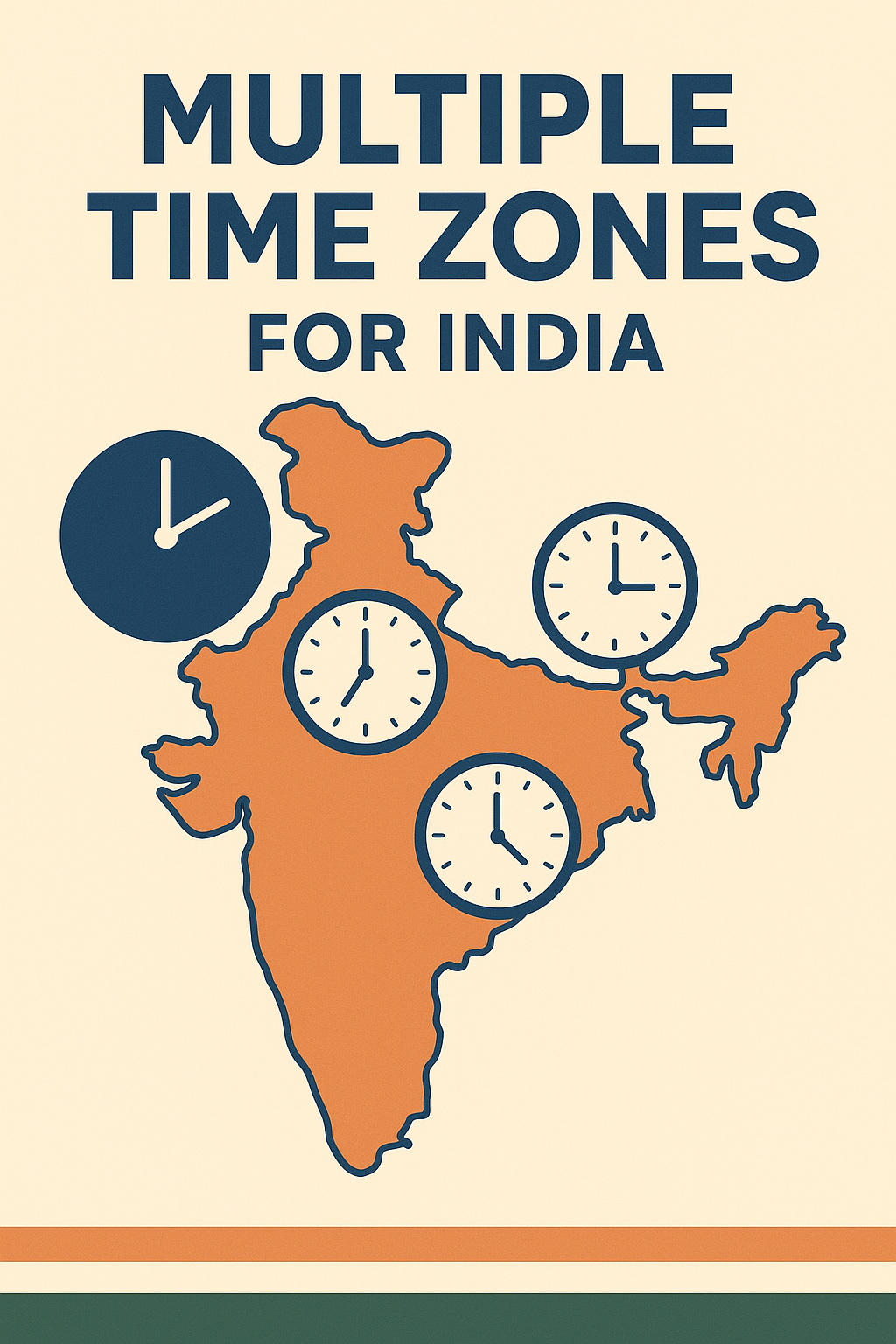
The territory of mainland India spans a longitude of approximately 30 degrees and covers an area of approximately 3.28 million square kilometres. Whereas, Tennessee, which is merely the 36th-largest state in the United States by area has a longitudinal spread of approximately 9 degrees and covers about 110,000 square kilometres. These facts when presented in isolation do not denote anything extraordinary, but their significance will become apparent once one understands what longitudes represent.
Longitude measures how far a place is east or west on the Earth. Because the Earth rotates 360 degrees in 24 hours, every 15 degrees of longitude corresponds to one hour of time difference. In other words, a shift of 1 degree in longitude equals roughly 4 minutes of solar time.
India’s 30-degree spread thus translates to a natural 2-hour difference in solar time between its easternmost and westernmost regions, and Tennessee’s 9-degree spread amounts to about 36 minutes of natural time difference across the state. This means that even though India functions under a single official time zone, different parts of the country experience sunrise, sunset and daylight patterns that can be up to two hours apart.
Herein lies the irony:
Tennessee, a region with only one-third of the landmass of India, operates with 2 time zones “(UTC -5/-4)” and “(UTC-6/-5)”. Whereas, India operates under a single time zone “UTC+05:30“. In the northeastern states, such as Assam, the sun rises as early as 4:30 AM during summer, yet typical office hours begin only at 9 or 10 AM. As a result, these regions lose four to five hours of usable daylight. This mismatch creates a myriad of new problems including increased electricity consumption, higher stress levels because humans are naturally inclined to work during daylight and rest after sunset, and additional safety concerns for individuals commuting alone in the dark.
The reasons cited by the Indian government for the continuation of this inefficient singular time zone use are as follows:
- Multiple time zones may lead to logistical confusion and accidents in railways – A weak argument considering the fact that larger countries such as Australia, Canada, Russia, United States of America, operating multiple time zones run perfectly functional complex train networks. The fear that “railways will break” is pure bureaucratic myth
- Political desire of uniformity, i.e, “One nation, one time zone” – When a reason such as this is presented, one must pause to ask the following questions:
- At what cost must such uniformity be achieved? Productivity and well-being of people across the country, increasing electricity and energy consumption?
- To what end is uniformity necessary?
- Administrative rigidity in adopting new systems – This is the closest to a legitimate reason, but a weak reason nonetheless. It points to deeper, systemic issues in how the government operates and its persistent inability to keep pace with change.
Whereas, here is the rationale for why dual time zones would be advantageous for India:
- Better alignment with natural daylight – A second time zone allows people to wake, work, and sleep in sync with the sun. This, in turn, has the potential to increase productivity, better health, among a few biological benefits.
- Drastic reduction of electricity consumption – Regions far to the east, to keep up with a single time zone, are forced to waste morning daylight and overuse luminous electricity consuming devices after sunset. According to economist Maulik Jagnani, India may be incurring annual human-capital costs of approximately USD 4.1 billion (around ₹29,000 crore), or about 0.2% of nominal GDP, simply due to the way time-zone boundaries are currently regulated. A 2018 paper titled “Necessity of two time zones: IST-I (UTC +5:30 h) and IST-II (UTC +6: 30 h) in India and its implementation” presents an argument that a separate time zone for the Northeast (and some eastern/Andaman regions) has the potential to improve productivity and reduce power consumption. The same study suggests that aligning clock-time with local sunrise and sunset will synchronise daily school/work hours with the presence of daylight, better matching people’s biological clocks and improving “efficiency of populace”.
- Historically, organisations such as Tata Energy Research Institute (TERI) in 1994, argued that multiple time zones in India would help stagger national energy demand and reduce peak pressures by spreading the load of the energy consumed. This practice, according to the study, would lead to a drop in energy consumption by 5.7 percent, resulting in an annual saving of 400 crores (INR).
In conclusion, the potential gains such as higher productivity, reduced power consumption, and overall improvement of national health far outweigh the modest adjustment required for adopting two time zones. With successful models abroad and credible support from Indian scientific bodies, it is reasonable to remain optimistic about achieving the anticipated benefits of implementing a dual time zone system in India.
Post Disclaimer
The opinions expressed in this essay are those of the authors. They do not purport to reflect the opinions or views of CCS.